![]() |
|
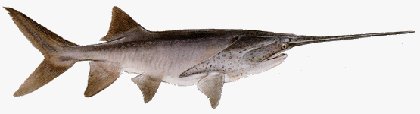
Paddlefish Variant Names: Spoonbill, spoonbill cat, shovelnose cat, boneless cat |
|
|
Description: Polyodon is a Greek word meaning "many tooth," and refers to the species' many gill rakers; spathula is Latin for "spatula" or "blade," and is an obvious reference to the fish's snout. The paddlefish may be distinguished from all other species by the broad, flat, bill-like snout (paddle). The paddle may be half as long as the body. Minus the snout, the paddlefish superficially resembles a shark. The tail is deeply forked, and the color is gray. However, paddlefish skin is smooth and scaleless. Underneath the snout the mouth is large and dangerous-looking, but has no teeth. |
|
|
Biology: In Texas, paddlefish spawn from early spring through early summer. Fish move upstream into spawning areas when the water temperature reaches about 50°F. Fast-flowing water (floods which last several days) and clean sand or gravel bottoms are required for successful spawning. During spawning paddlefish gather in schools. Details are not well understood, but it is believed several males accompany a female. Eggs and sperm are released as the fish swim over suitable habitat. The eggs are sticky and adhere to solid objects such as rocks. Incubation takes about nine days at 57°F. The snout does not become prominent for several weeks after the fry hatch. Young fish grow quickly. Growth of six inches or more has been reported in several months, 12 to 14 inches is typical for the first year, but growth potential is even higher. Fish less than eighteen months old have attained lengths of three feet in controlled pond situations. Generally, fish become sexually mature at 5-10 years of age, and may live to be 20-30 year |
|
|