![]() |
|
American Eel Variant Names: Freshwater Eel |
|
|
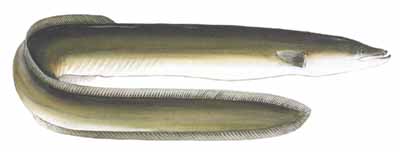
Description: Anguilla and rostrata are both Latin, meaning "eel" and "beaked," respectively. The latter is probably a reference to the fish's snout. The American eel has a slender snakelike body with very small scales, and the fish may appear naked. A long dorsal fin usually extends for more than half the length of the body and is continuous with a similar ventral fin. Pelvic fins are absent. The back may be olive-green to brown shading to greenish-yellow on the sides and light gray or white on the belly. |
|
|
Biology: Like the European eel, the American eel spawns during the winter in the Sargasso Sea, a tropical area northeast of Cuba. Adult eels spend most of their lives in freshwater, although the amount of time may vary among individuals. At some point, however, adults leave their freshwater habitats and move toward the Sargasso Sea. Neither adults or eggs have been collected in the vicinity of the Sargasso Sea, but newly hatched eels are found there. Presumably, spawning takes place in deep water and the adults die shortly thereafter. Young eels are transparent and leaf shaped. Years ago when they were first collected they were thought to be a new fish species and erroneously give the scientific name Leptocephalus. Within about a year, growing and moving toward the mainland, the American eels transform into more eel-like forms called "glass eels" or "elvers" and are ready to enter freshwater (European eels have a much longer journey and the process takes about three years). By the time American eels get close to the |
|
|