![]() |
|
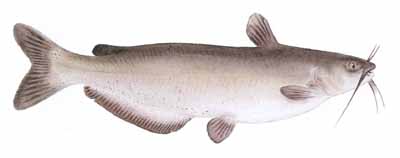
Channel Catfish Variant Names: Willow Cat, Forked-Tail Cat, Fiddler, Spotted Cat, Lady Cat |
|
|
Description: Ictalurus is Greek and punctatus is Latin, meaning "fish cat" and "spotted," respectively. Channel catfish are easily distinguished from all others, except blue catfish, by their deeply forked tail fin. Unlike flathead catfish, the upper jaw projects beyond the lower jaw. Coloration is olive-brown to slate-blue on the back and sides, shading to silvery-white on the belly. Typically, numerous small, black spots are present, but may be obscured in large adults. The anal fin has 24-29 soft rays, in contrast to the blue catfish which always has 30 or more rays in the anal fin. |
|
|
Biology: Channel catfish are most abundant in large streams with low or moderate current. They spawn in late spring or early summer when water temperatures reach 75°F. Males select nest sites which are normally dark secluded areas such as cavities in drift piles, logs, undercut banks, rocks, cans, etc. A golden-yellow gelatinous egg mass is deposited in the bottom of the nest. Males guard the nest, and may actually eat some of the eggs if they are disturbed. The eggs, if not devoured, typically hatch in about a week. Fry remain in the nest, under the guardianship of the male, for about another week. In clear water, young fish appear to be much more susceptible to predation and survival rates during the first year of life are much lower. Channel catfish less than 4 inches in length feed primarily on small insects. Adults are largely omnivorous, feeding on insects, mollusks, crustaceans, fish, and even some plant material. Sexual maturity is reached in two or three years in captivity, whereas data from natural populati |
|
|