![]() |
|
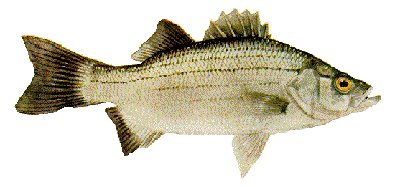
White bass Variant Names: Sand Bass, Barfish, Streaker, Silver Bass |
|
|
Description: Morone is of unknown derivation. The species epithet chrysops is Greek meaning "golden eye." As with other true basses, the dorsal fin is clearly double, separated into spiny and soft-rayed portions. White bass are silvery shading from dark-gray or black on the back to white on the belly. Several incomplete lines or stripes run horizontally on each side of the body. Adults resemble young striped bass, and the two are often confused. However, striped bass have two distinct tooth patches on the back of the tongue, and white bass have one tooth patch. Striped bass have two sharp points on each gill cover, as opposed to white bass which have one, and the second spine on the anal fin is about half the length of the third spine in striped bass, whereas it is about two-thirds the length of the third spine in white bass. |
|
|
Biology: White bass are active early spring spawners. Schools of males migrate upstream to spawning areas as much as a month before females. There is no nest preparation. Spawning occurs either near the surface, or in midwater. Running water with a gravel or rock substrate is preferred. Females rise to the surface and several males crowd around as the eggs and sperm are released. Large females sometimes release nearly a million small eggs during the spawning season. After release eggs sink to the bottom and become attached to rocks, hatching in 2-3 days. Fry grow rapidly, feeding on small invertebrates. White bass may grow eight or nine inches during the first year. Adults are usually found in schools. Feeding occurs near the surface where fish, crustaceans, and emerging insects are found in abundance. Gizzard and threadfin shad are the preferred food items. White bass more than four years of age are rare. |
|
|