![]() |
|
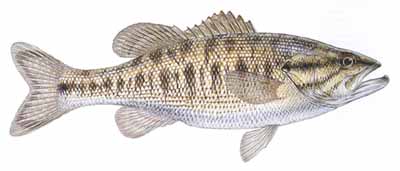
Guadalupe Bass Variant Names: Black Bass, Guadalupe Spotted Bass |
|
|
Description: The Guadalupe bass, like other "black bass" including largemouth, smallmouth, and spotted bass, is not a true bass at all but a member of the sunfish family Centrarchidae. Micropterus is Greek, meaning "small fin" and is a rather unfortunate misnomer arising from an injured type specimen that made it appear that the posterior rays of the soft dorsal fin formed a small separate fin. Treculi refers to Trecul, the French compatriot of Vaillant and Bocourt. Trecul actually caught the specimen. The Guadalupe bass is generally green in color and may be distinguished from similar species found in Texas in that it doesn't have vertical bars like smallmouth bass, its jaw doesn't extend beyond the eyes as in largemouth bass, and coloration extends much lower on the body than in spotted bass. |
|
|
Biology: Both males and females become sexually mature when they are one year old. Guadalupe bass spawning begins as early as March and continues through May and June. A secondary spawn is possible in late summer or early fall. Like all other black bass, Guadalupe bass build gravel nests for spawning, preferably in shallow water. As with spotted bass and smallmouth bass, males tend to build nests in areas with higher flow rates than largemouth bass. When a male has successfully attracted a female to the nest she may lay 400 to over 9,000 eggs. The female is then chased away and the male stands guard over the incubating eggs. After hatching, fry feed on invertebrates and switch to piscivory as they grow older. Very young fish and older adults tend to include more invertebrates in their diet than do largemouth bass. Juveniles and younger adults tend to include more fish in their diets than do largemouth bass. |
|
|