![]() |
|
Largemouth Bass Variant Names: Black Bass, Green Trout, Bigmouth Bass, Lineside Bass |
|
|
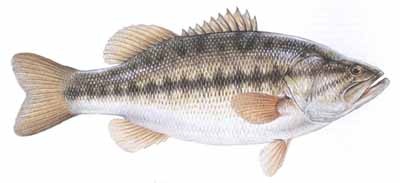
Description: Two subspecies of largemouth bass exist in Texas: the native Micropterus salmoides salmoides and the Florida largemouth bass, Micropterus salmoides floridanus.The two subspecies are visually indistinguishable, although they may be distinguished by genetic testing procedures. Both are usually green with dark blotches that form a horizontal stripe along the middle of the fish on either side. The underside ranges in color from light green to almost white. The dorsal fin is almost divided, with the anterior portion containing 9 spines and the posterior portion containing 12-13 soft rays. Largemouth bass may be distinguished from other black basses in that the upper jaw reaches far beyond the rear margin of the eye. Micropterus is Greek, meaning "small fin" [see Guadalupe bass for further explanation]. Salmoides is from the Greek salmo, meaning "trout", and refers to the fact that largemouth bass have been called "trout" in some southern states. |
|
|
Biology: Spawning begins in the spring when water temperatures reach about 60°F. This could occur as early as February or as late as May, depending one where one is in the state. Largemouth bass prefer to nest in quieter, more vegetated water than other black bass, but will use any substrate besides soft mud, including submerged logs. Nests are usually built in two to eight feet of water. As in Guadalupe bass, once the female has laid eggs in the nest (2,000 to 43,000) she is chased away by the male who then guards the precious eggs. The young, called fry, hatch in five to ten days and remain in a school. Male largemouth bass continue to guard their fry for several days after hatching. Fry feed primarily on zooplankton and insect larvae. At about two inches in length they become active predators. Adults feed almost exclusively on other fish and large invertebrates such as crayfish. |
|
|